
Multi-Cat Households: Why Visit Frequency Matters More Than You Think
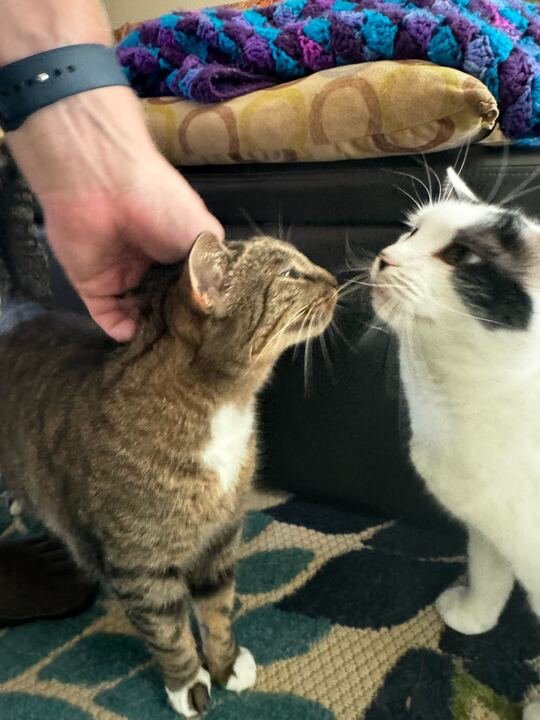
If you have two cats, you've probably been told they'll "keep each other company" while you're away.
That's partially true. But it skips over something important: multi-cat households are more socially complex than single-cat households, not simpler. And when the human anchor of that social system — you — leaves town, the dynamics between your cats can shift in ways that create stress, conflict, or health concerns that a once-daily drop-in visit is unlikely to catch.
Funky Bunch Pet Care has cared for a lot of multi-cat households in Springfield, MO. Here's what we've learned about what those households actually need.
The myth of the self-managing multi-cat home
The assumption goes like this: you have two cats, they're bonded, they entertain each other, so they need less attention from a sitter than a single cat would.
In practice, the opposite is often true.
A single cat's routine is relatively predictable. She eats her food, uses her litter box, finds her spot, and waits for your return. Her stress responses are her own.
Two cats share a social system that you are part of. You're a resource, a mediator, and a source of stability. When you leave, that system has to recalibrate without you. Most of the time it does fine — but "fine" isn't always obvious, and the failure modes in multi-cat households are specific.
What can actually go wrong
Resource competition. Even bonded cats can compete for resources when the household routine is disrupted. Food, water, litter box access, preferred resting spots — these are all potential friction points. If one cat is more dominant, she may eat the other's food, block access to certain rooms, or claim the litter box in ways that cause the other cat to go elsewhere.
A sitter who comes once a day, fills one shared bowl, and leaves doesn't always have enough information to know whether both cats ate.
Stress from the other cat's stress. Cats in the same household regulate off each other. If one cat becomes stressed — from your absence, from a change in routine, from a conflict over resources — the other cat often picks up on it. Stress is somewhat contagious in multi-cat households, especially in bonded pairs.
Litter box problems that are harder to track. With one cat, a litter box issue is immediately obvious: one cat, one box, one pattern to monitor. With two cats, it's possible for one cat to stop using the box (a common stress response) while the other continues normally — and a quick visit that shows "the box was used" doesn't tell you whether it was used by both cats.
Health concerns that look like social behavior. A cat who isn't eating, isn't active, or is hiding more than usual might seem like she's just deferring to her housemate. A trained eye who knows both cats' individual baselines will catch this. A sitter who sees "two cats present, everything seems fine" may not.
What visit frequency actually accomplishes
More frequent visits don't just mean more food refills. They mean more data points.
When a sitter visits twice a day rather than once, they're building a picture of each cat's individual behavior over the course of the day. They see which cat is eating and which one isn't. They see who used the litter box. They catch early signs of resource competition — one cat blocking the other from a room, or a cat eating faster than usual because she's worried about access.
They also have more opportunity to intervene. Separating food bowls. Adjusting where food is placed. Checking that water is being consumed. Noticing that the cat who was hiding yesterday is still hiding today.
With multi-cat households, we typically recommend twice-daily visits — not because cats are inherently high-maintenance, but because twice-daily visits give us the information we need to actually confirm that both cats are doing well, not just that the household looks undisturbed.
The litter box math
Here's a practical consideration that doesn't come up enough: the recommended rule for litter boxes is one box per cat, plus one. Two cats means three boxes, ideally.
When you're home, you're monitoring litter box usage informally — you notice things in passing. When you're away and a sitter visits once a day, litter box monitoring drops to a brief check once every 24 hours.
If your household has two cats and two boxes, a once-daily visit means each box might go 24 hours between scoops. That's a long time, and cats who are already slightly stressed may begin avoiding a box that feels too dirty — which creates a litter box avoidance cycle that can be hard to break.
Twice-daily visits mean boxes get checked (and scooped if needed) twice a day. That's better for hygiene and significantly better for preventing avoidance behavior.
Individual attention in a multi-cat home
Bonded cats often do things together — nap in the same room, groom each other, play together. It can look like they're getting plenty of social interaction from each other.
But cats in bonded pairs still want individual attention from humans. The cat who hangs back while her more confident housemate claims the sitter's lap isn't necessarily fine with missing out — she may just be deferring, which is its own kind of stress signal.
A good sitter in a multi-cat household makes time for each cat individually. That requires staying long enough and paying enough attention to make sure the quieter or more reserved cat isn't getting skipped.
What to tell your sitter about your specific cats
Before you leave town, make sure your sitter has individual baselines for each cat — not just household-level information.
Helpful things to share:
- What each cat normally eats and approximately how much
- Which cat uses which litter box if they have preferences
- Whether either cat tends to hide or withdraw when stressed
- How they interact with each other when everything is normal — so changes are noticeable
- Any history of resource competition, litter box issues, or stress-related health problems
- Which cat is likely to approach the sitter and which one may not
At Funky Bunch Pet Care, we gather this information during the meet and greet — for each cat individually, not just for the household. It's the difference between managing a home and actually knowing the animals who live in it.
Frequently asked questions
Do two cats need more visits per day than one cat?
Often, yes. Multi-cat households have more complex social dynamics, more litter box monitoring needs, and more potential for one cat's condition to be masked by the other's normal behavior. Twice-daily visits give a sitter enough data to confirm that both cats — individually — are doing well.
My cats are bonded and inseparable. Do they still need extra care when I'm gone?
Bonded cats often experience your absence more acutely because they're used to a stable three-way social system. The disruption of one element — you — affects the whole system. Bonded cats may actually need more attention from a sitter, not less.
How do I know if both my cats are eating when I'm away?
Individual food bowls placed in separate locations, combined with a sitter who visits frequently enough to observe both cats during or after mealtime, is the most reliable approach. A sitter who arrives once a day to a clean bowl only knows that food was consumed — not which cat ate it, or how much each one got.
What's the right number of litter boxes for two cats?
The standard recommendation is one box per cat plus one — so three boxes for a two-cat household. During travel, boxes should be scooped at least once daily, ideally twice, to prevent avoidance behavior in stressed cats.
How do I find a cat sitter in Springfield who has experience with multi-cat households?
Ask directly during the consultation. A sitter with multi-cat experience will ask you about each cat individually, discuss resource management, and have a clear approach to monitoring both cats during visits. Funky Bunch Pet Care serves multi-cat households throughout Springfield and the surrounding area.
---
Funky Bunch Pet Care provides professional, in-home cat sitting for single and multi-cat households throughout Springfield, MO. Our Fear Free certified, W-2 team tracks each cat individually and communicates after every visit through Time to Pet.